Jun 2, 2026 · 3 min read
AI speed still needs human review
AI can speed up the first draft, but you still need review, context, and human expertise to make the work hold up.
What changes
A fast draft is useful after you write the decision it must support.
Try first
Before prompting, write: My recommendation is ___ because ___.
Listen to the AI-generated version on Spotify. Spotify
Why faster responses do not remove the need for human judgment. It may increase it.
The Productivity Promise
Most conversations about AI in the workplace start by asking how it can increase speed and reduce costs. Given stretched resources and time-constraints, this would makes sense. A tool promising reduced effort and faster drafting naturally attracts attention.
However, this framing is too narrow. It assumes drafting is the primary bottleneck in knowledge work. In reality, the harder work requires evaluating attention, testing assumptions, weighing trade-offs, and catching weak reasoning. AI lacks the necessary environmental context; which can only be understood by the human experience.
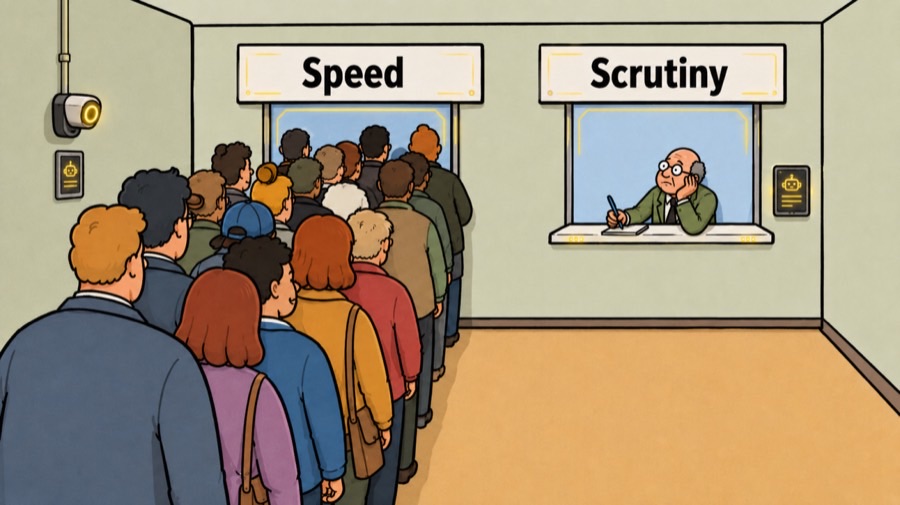
The Productivity Paradox. Speed vs Scrutiny.
The paradox of AI is that while it accelerates drafting, it amplifies the need for evaluation. Generative AI changes the nature of work by proposing wording, structure, and interpretations before the user forms a viewpoint. This shifts users from generating ideas to merely reacting to them.
Consequently, the effort saved upfront could reappear later as verification, correction, and judgment. Productivity claims focus on the speed of the first draft, ignoring the rigorous effort required to make the output accurate and defensible.
What This May Be Doing to Human Cognition
Use It At Work
Try one move on a real task.
Before prompting, write: My recommendation is ___ because ___.
This is where I think the issue becomes more interesting.
Research on cognitive offloading shows that people regularly use external tools to reduce the demands placed on memory and attention (Risko & Gilbert, 2016). That is not new. We already rely on calendars, notes apps, navigation tools, and search engines.
But generative AI feels different because it is not just storing information for later. It is participating in the early stages of thinking and that may have consequences.
Research on automation bias suggests people are more likely to rely on automated systems under conditions like workload, task difficulty, time pressure, and uncertainty (Goddard et al., 2012). That matters because those are exactly the conditions under which many professionals are using AI now.
Earlier work also found that when people expect information to remain accessible through technology, they become less likely to remember the information itself and more likely to remember where to find it (Sparrow et al., 2011).
I do not think this means AI is making people less intelligent. I do think it raises a serious question: if reasoning improves through practice, what happens when professionals spend less time doing the first layer of reasoning themselves and delegate that portion to the AI?
Why Expertise Still Matters
One of the more common stories around AI is that better tools will make expertise less important. I am not convinced of this.
A polished first draft is not the same thing as sound judgment which takes into account all possible non-text information in the environment. The AI draft can create options. It can suggest a direction. But someone still has to decide whether the framing makes sense, whether the assumptions hold up, whether the trade-offs are acceptable, and whether the final output is something they can defend in the real world.
That is where expertise still matters.
Experienced professionals often notice what the draft leaves out. They catch weak context, false confidence, shallow reasoning, and risks that do not show up on the surface. In a workplace filled with plausible-sounding output, that ability may become even more valuable.
How You Can Stay in Control
The solution is not to avoid AI, but to use it while remaining connected to the reasoning process.
Maintain control by forming a preliminary viewpoint before prompting. Actively type out the specific problem. Use AI to challenge your thinking—asking it to surface assumptions, identify weak spots, or offer counterarguments—rather than simply letting it complete the task for you.
Evaluate whether your workflow requires enough cognitive engagement to defend the final result. If it does, AI strengthens your work; if not, the unseen cost of speed could severely compromises your output. These are risks which the narrative does not discuss, yet is important to know when making en educated decision about when to/not to use AI.
Put it to work
Check the draft before it leaves you.
- Circle claims that need a source.
- Delete wording you could not explain out loud.
- Add the missing context from your workplace, client, or class.
Sources used3
- Goddard, K., Roudsari, A., & Wyatt, J. C. (2012). Automation bias: A systematic review of frequency, effect mediators, and mitigators. Journal of the American Medical Informatics Association, 19(1), 121–127. https://doi.org/10.1136/amiajnl-2011-000089
- Risko, E. F., & Gilbert, S. J. (2016). Cognitive offloading. Trends in Cognitive Sciences, 20(9), 676–688. https://doi.org/10.1016/j.tics.2016.07.002
- Sparrow, B., Liu, J., & Wegner, D. M. (2011). Google effects on memory: Cognitive consequences of having information at our fingertips. Science, 333(6043), 776–778. https://doi.org/10.1126/science.1207745