May 19, 2026 · 4 min read
Human-centred AI starts with control
Human-centred AI starts with the work people need to do, the control they need to keep, and the decisions they still own.
What changes
Responsible AI needs a named owner, approval point, and stop rule.
Try first
Write three lines: owner, evidence needed, reject when.
Start With the Work, Not the Tool
I have noticed this term “human-centered” becoming closely associated with AI: strategy decks, product announcements, vendor demos, leadership updates, and conversations about responsible adoption.
The phrase sounds useful. It may suggest that people still matter and that technology is being designed around human needs. But the more often I see it, the more I wonder whether the language is doing more reassuring than explaining, and whether the value of the term is being distorted.
Human-centered technology did not begin with AI. It grew out of ergonomics, human factors, and later human-computer interaction. The concern was practical:
During World War II, this became more formal as complex machines exposed the cost of poor design. Later, as computers entered everyday work, the focus moved toward software and user experience. Now, with AI, I think the question has shifted again: does the workflow preserve enough human control for people to use automation without losing their human judgement?
Shneiderman (2020) describes Human-Centered AI as an approach that should support human control while still using automation where it helps.
That feels like a stronger standard than keeping a person somewhere near the final decision. To me, human-centered technology should describe how much control a person has while using a workflow.
Can they understand what the technology is doing? Can they adjust it to fit the task? Can they pause, override, or reject its direction? Can they use it without losing sight of their own judgment, standards, and responsibility?
AI is now being used in work where human decision making still carries consequences: credit decisions, hiring shortlists, legal review, patient triage, insurance claims, and financial risk reporting. In those settings, speed alone does not seem like enough. A tool can produce a polished answer quickly and still leave the human with too little visibility to know whether the answer is sound.
Control and Efficiency Can Work Together
The clearest research frame still comes from Ben Shneiderman.
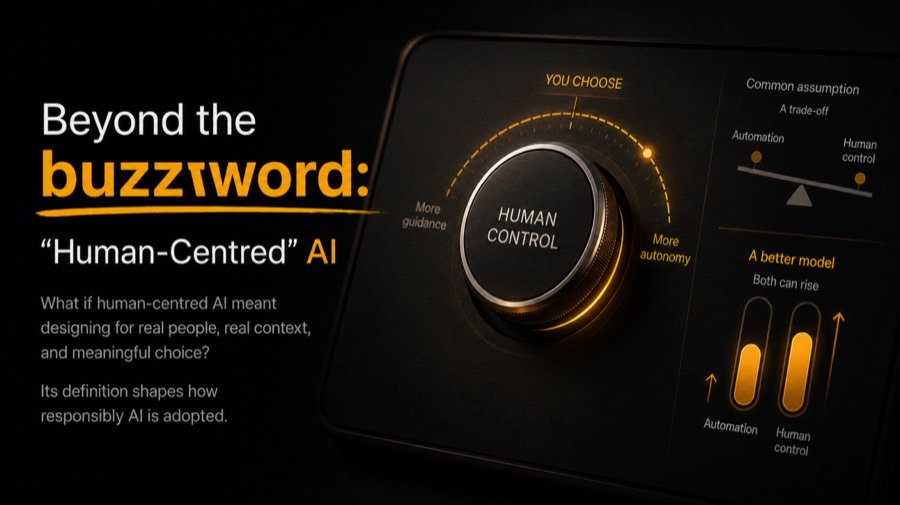
Shneiderman (2020) argues that human control and computer automation should not be treated as opposites. His framework separates them into two dimensions. In that model, a workflow can aim for both high automation and high human control.
A simple example is cruise control.
You still choose the speed. You can still steer. You can still brake. You can override the workflow when the road changes. The workflow reduces effort, but it does not remove your control.
I think this is a useful lesson for AI. A well-designed workflow can automate parts of the task while still helping the person steer, inspect, correct, and take responsibility for the outcome.
If we assume automation always means less control, we create a false trade-off. We either move faster, or we stay in charge. Shneiderman’s framework suggests that design can aim for both.
Why Control Matters
Use It At Work
Try one move on a real task.
Write three lines: owner, evidence needed, reject when.
Control changes what people can actually do with the tool.
A person has control when they can see the evidence behind the workflow’s response and has the choice to assert their agency in the interaction. They have control when they can undo, reject, compare, or escalate the output before it affects the quality of the work.
Without an awareness of those options, the human may only be present at the end. That can create weak oversight because the person is asked to approve work which they cannot modify.
This connects to automation bias. Goddard, Roudsari, and Wyatt (2012) define automation bias as the tendency to over-rely on automation. Their review found that workload, task difficulty, time pressure, trust, confidence, and user experience can affect that reliance.
So when an AI workflow produces polished work quickly and the person is rushed, control becomes more important.
Start With the Person
I was inspired to learn more about what "Human Centered" actually means when I saw a clip of Steve Jobs at Apple’s 1997 Worldwide Developers Conference.
Steve Jobs said teams should start with the customer experience and work backward to the technology. He warned against starting with the technology and then trying to find a place to sell it (Jobs, 1997) and I think that is a helpful correction for AI.
It should begin with: what decision does this person need to make, what control do they need to keep, what should the technology handle how do we promote responsible use?
The Second Pass
I think one useful test for human-centered AI is control.
How much influence does the person have before the output becomes part of the work? What evidence can they inspect? Where does the workflow show uncertainty or missing context? What can they do to change the AI's response? With general AI tools like ChatGPT, where workplace guidance is often unclear, how intentional are you with the instructions you provide? Are you using the tool to replace your thinking, or to test, challenge, and improve it?
But human-centered AI should not ask people to trade control for speed.
A stronger standard may be this: automate the parts of the work that reduce unnecessary effort, while preserving the human control needed for judgment, accountability, and quality.
Put it to work
Use this control check.
- Who approves the output?
- What proof do they need?
- What would make them reject it?
Sources used3
- Goddard, K., Roudsari, A., & Wyatt, J. C. (2012). Automation bias: A systematic review of frequency, effect mediators, and mitigators. Journal of the American Medical Informatics Association, 19(1), 121–127. https://doi.org/10.1136/amiajnl-2011-000089
- Jobs, S. (1997, May 13). WWDC closing chat [Transcript]. All About Steve Jobs. https://allaboutstevejobs.com/videos/misc/wwdc_1997_closing_chat
- Shneiderman, B. (2020). Human-centered artificial intelligence: Reliable, safe & trustworthy. arXiv. https://arxiv.org/abs/2002.04087