Apr 30, 2026 · 6 min read
Measure AI by rework, trust, and time
Time saved matters, but AI value also shows up in better decisions, less rework, and work people can trust.

What changes
AI ROI shows up in four places: time saved, fewer corrections, faster decisions, and more client time.
Try first
Pick one weekly workflow and record the four numbers before you expand the tool.
Listen to the AI-generated long-form version on your commute.
TL;DR
Using time savings as a metrics of AI ROI is too small. Time saved matters, but it does not capture the full value of generative AI. The better question is what changed because AI was involved. Did the quality of work increase? Did the person learn something? Did it reduce rework? Did the final output become easier to trust? If a task still takes the same amount of time with AI, that does not automatically mean AI failed. The better question is what happened inside those five hours, which is harder to measure but arguably more important.
If you only measure time saved, you may miss the real value of the work
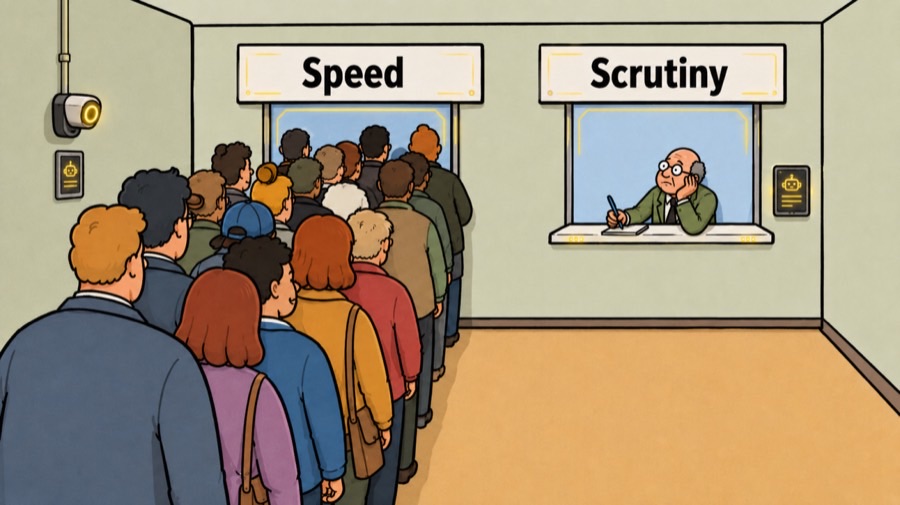
Most AI business cases still start with one question: how much time did this save? For all the talk about transformation, many organizations still evaluate AI like a stopwatch. How many minutes did it save? How many emails did it write? How many slides did it produce? Much like pounds on a weightlifting bar, time is easy to measure, but it does not tell us whether the final work became stronger, clearer, or easier to trust.
If the only question is “Did AI make this faster?”, then we are measuring the tool against the smallest version of its potential. The better question is what changed because AI was involved.
What I’ve Noticed
I keep seeing the same assumption show up in AI conversations at work: if a task still takes the same five hours with AI, something went wrong. That sounds logical at first. If AI improves productivity, a five-hour task should become a three-hour task, or maybe a one-hour task, depending on how optimistic the software vendor is feeling. This is partly because speed is the easiest outcome to see before people have learned how to judge whether AI improved the work itself.
But when people use AI well, the pattern is more complex. Sometimes the task takes less time. Sometimes it takes the same amount of time or even more time, but the person uses that time differently. They test more ideas, compare stronger alternatives, notice gaps earlier, and learn something they would have skipped if they were only trying to finish.
The Gap
Use It At Work
Try one move on a real task.
Pick one weekly workflow and record the four numbers before you expand the tool.
The research shows AI can improve speed and quality together. That is exactly why a time-only metric is incomplete. In a July 2023 Science study of 453 college-educated professionals completing writing tasks, ChatGPT reduced average completion time by 40% and improved output quality by 18% (Noy & Zhang, 2023, July 14). A separate April 2023 NBER working paper studying 5,179 customer support agents found that access to a generative AI assistant increased productivity by 14% on average, including a 34% improvement for novice and low-skilled workers (Brynjolfsson, Li, & Raymond, 2023, April).
These findings support the productivity case, but they also point to something more useful. The value was not only that people produced more. The value was that some people had access to structure, examples, phrasing, and patterns that changed how they approached the task. They developed their own scalable method which translated to other work. That is a capability gain, not just a time saving.
The First Pass: AI as a Stopwatch
The first pass of AI adoption treats generative AI like a faster version of existing software. You give it a task, it gives you output, and someone counts the minutes saved on a dashboard. This creates a clean business case, but it also rewards the wrong behavior when speed becomes the main goal.
If workers are measured mainly on speed, they will use AI to produce faster drafts. If teams are praised for volume, they will generate more documents, summaries, slides, and messages. Some of that will help, but some of it becomes polished clutter that moves the real work downstream. The draft looks complete, but someone else has to supply the missing context, judgment, and accountability which adds more work.
BetterUp Labs and Stanford Social Media Lab reported in 2025 that 40% of U.S. desk workers had received “workslop” in the previous month, with each incident taking an average of two hours to resolve. Their findings were based on a September 2025 online survey of 1,150 full-time U.S. desk workers (BetterUp Labs & Stanford Social Media Lab, 2025).
The Second Pass: AI as a Capability Expander
The better question is what changed because AI was involved. That question still includes efficiency, but it also includes quality, learning, judgment, and reach. This is harder to measure, quantitatively.
A person may spend the same five hours on a task and still create more value. They may clarify the problem, generate options, compare trade-offs, check weak spots, and revise the final AI output into something better than they could have done without AI, while still standing behind the result. On a timesheet, the task still took five hours. In the work itself, something changed.
The Expert Pivot
This is where expertise matters. Generative AI does not remove the need for judgment. It increases the number of moments where judgment has to be applied. The tool can produce a draft, suggest language, and surface patterns, but the person still decides what is accurate, relevant, appropriate, and useful.
The Practical Path
A better AI ROI model should measure five observable changes (including speed):
Speed: How long did it take to complete the task? Quality: Did the final output require fewer edits before it could be used? Capability: Could the person now complete a task they previously avoided or outsourced? Learning: Could they explain why the final version is stronger than the first draft? Rework: Did this reduce clarification, correction, or cleanup for others?
Example: A professional spending five hours on a strategic brief uses AI to stress-test their logic and simulate counter-arguments. While the time spent (Speed) is unchanged, the brief is more robust (Quality), the author masters new competitive analysis frameworks (Learning), they handle complex financial modeling previously sent to a specialist (Capability), and the final version requires zero follow-up clarification from executives (Rework).
This is the practical test. If AI saves one hour for the sender and creates two hours of cleanup for the receiver, that is not productivity. That is task displacement wearing a nicer outfit.
The First Pass Narrative
The corporate AI conversation has spent a lot of time asking whether AI makes work faster. It can. But the more useful question is whether AI helps people produce work that is better, more thoughtful, more complete, and easier to trust.
That shift matters because it changes the behavior we encourage. If we reward speed alone, people will use AI to produce faster first drafts. If we reward quality, learning, and reduced rework, people will use AI more carefully. A useful AI workflow should leave the person with better, stress-tested output and a clearer understanding of future work required.
Put it to work
Fill in this scorecard.
- Minutes from request to finished work.
- Corrections or follow-up questions.
- Client-facing hours returned to the week.
Sources used3
- BetterUp Labs & Stanford Social Media Lab. (2025). Workslop: The hidden cost of AI-generated busywork. BetterUp. https://www.betterup.com/workslop
- Brynjolfsson, E., Li, D., & Raymond, L. R. (2023). Generative AI at work (NBER Working Paper No. 31161). National Bureau of Economic Research. https://doi.org/10.3386/w31161
- Noy, S., & Zhang, W. (2023). Experimental evidence on the productivity effects of generative artificial intelligence. Science, 381(6654), 187–192. https://doi.org/10.1126/science.adh2586